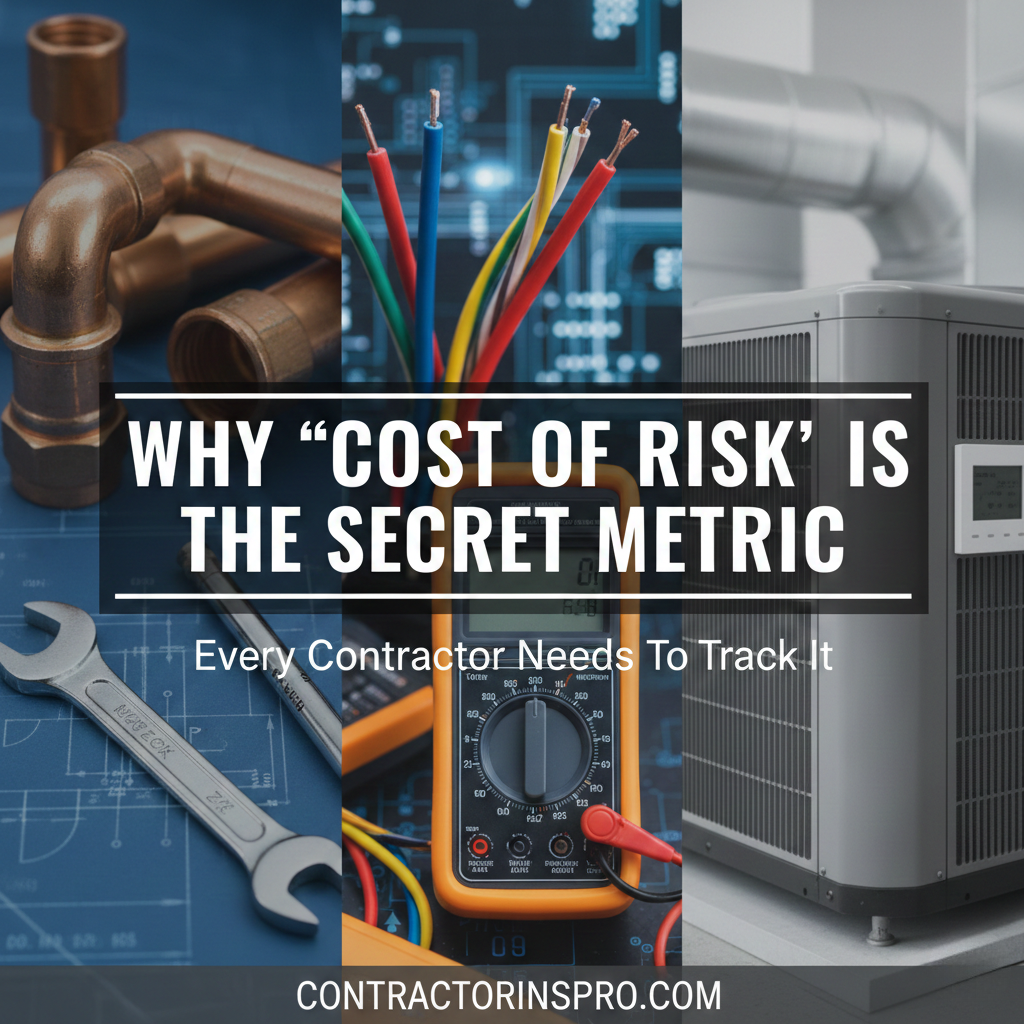
Why "Cost of Risk" is the Secret Metric Every Contractor Needs to Track
As a plumbing, electrical, or HVAC business owner, you likely view insurance as a "fixed cost", a necessary evil to get on the job site. But at Contractor Insurance Pros, we look at it differently.
In a recent industry briefing, we dove deep into a concept called the Cost of Risk (CoR). Understanding this metric can be the difference between a year in the red and a record-breaking profit margin.
What is the "Cost of Risk"?
In the world of MEP (Mechanical, Electrical, and Plumbing) contracting, we deal primarily with hazard risk. This is the potential for accidental loss, think a burst pipe on a new build, an electrical fire, or an HVAC tech getting injured on a ladder.
Unlike "speculative risk" (like bidding on a new project where you might win or lose money), hazard risk only has a downside. The Cost of Risk is the total price tag of managing that downside.
The 4 Pillars of Your Risk Expenses
To lower your costs, you have to know where the money is going. The Cost of Risk is made up of four main areas:
Transfer Costs: This is your insurance premium. You are paying a carrier to take the risk off your shoulders.
Retained Losses: These are the costs you pay out of pocket, your deductibles or the small "fender benders" and tool thefts that aren't worth filing a claim for.
Loss Control Expenses: The money you spend to prevent accidents, like safety training, high-quality PPE, or telematics for your van fleet.
Administrative Costs: The time and money spent managing certificates of insurance (COIs), filing claims, and staying compliant.
How to Turn Risk into Profit
The goal isn’t just to buy the cheapest insurance; it’s to minimize the total cost per unit of risk. Here is how the most profitable contractors do it:
Strategic Retention: If your HVAC firm has an impeccable safety record, you might choose a higher deductible. Why? Because the money you save on premiums (the "return" on your risk) stays in your bank account rather than the insurance company's.
Investing in Prevention: Spending $2,000 on better ladder safety training (Loss Control) might feel like an expense, but if it prevents a $50,000 Workers' Comp claim and the resulting premium spike, your Cost of Risk actually goes down.
Internal Efficiency: By using a niche agency like Contractor Insurance Pros, we handle the heavy lifting of administrative risk management, freeing up your team to focus on billable hours.
The Bottom Line
Every dollar you shave off your Cost of Risk goes directly to your net income. When you reduce accidents and optimize your insurance structure, you aren't just "being safe", you are making your business more competitive.
Is your current insurance agent talking to you about your total Cost of Risk, or just quoting premiums?
At Contractor Insurance Pros, we specialize in the unique exposures faced by plumbers, electricians, and HVAC pros. We don't just sell policies; we help you manage the financial impact of risk so you can grow your business.
Latest Posts